Mud-Pond Curing: How Cirebon Produces Natural Weathered Kubu Grey
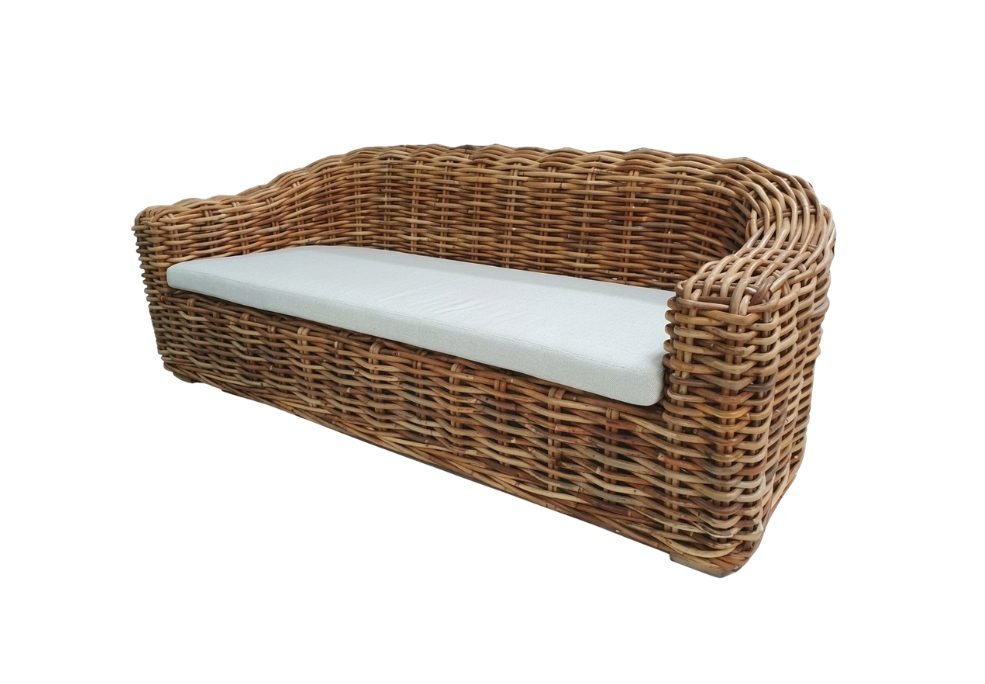
In short: True Kubu Grey is a curing process, not a paint. Unpeeled rattan poles are submerged for 4 to 6 weeks in mineral-rich clay ponds in Cirebon, where the minerals react with the bark's tannins.
What makes Kubu Grey different from dyed grey?
Unlike synthetic grey poly-wickers or solvent-dyed imitations that scratch off or emit strong chemical odors, true Indonesian Kubu Grey is a geological and biological process.
Step 1: Submerging unpeeled poles in mud-silt ponds
Thick, unpeeled rattan poles harvested from sustainable rainforest canopies are submerged directly into natural, mineral-rich mud silt ponds across Cirebon for 4 to 6 full weeks.
Step 2: The mineral and tannin reaction
During this immersion, natural iron and sulfur minerals in the clay react with the natural tannins inside the rattan bark. This chemical bonding creates a permanent, non-toxic weathered ash-grey tone that permeates the outer skin of the vine.
Step 3: Washing, drying and sealing
Once removed, the vines are power-washed in clean mountain spring water, sun-dried, and finished with a non-toxic water-based matte sealant. The result is a tactile, organic material with infinite nuance that gracefully ages over decades.
Why curing takes 4 to 6 weeks
The reaction between clay minerals and bark tannins is gradual. A shorter soak gives a patchy, pale tone that fades, while the full period lets the color work into the outer skin rather than sitting on top of it. This is also why the process cannot be rushed to hit a tight deadline, and why we plan Kubu Grey lead times from the start of curing.
How to tell real Kubu Grey from a dyed imitation
- Check a scratch: on a dyed surface, a fingernail can lift the color to show a lighter layer. Cured Kubu keeps its tone.
- Smell the product: solvent dyes can leave a sharp chemical odour, especially in a closed carton.
- Look for variation: real curing produces natural shade differences between poles, not perfect uniformity.
- Ask the process: a factory that cures its own poles can describe the pond, the time and the washing.
Caring for Kubu Grey furniture
Keep Kubu Grey furniture away from continuous rain and strong direct sun, dust it with a dry or slightly damp cloth, and avoid harsh solvents. A light matte re-seal every few years keeps the surface fresh. Give your retail customers this guidance, as it reduces returns and keeps pieces looking right.
Where Kubu Grey fits in our range
Kubu Grey is used across our living suites, lounge chairs and woven storage. Because it is a natural tone, it pairs well with recycled teak, linen cushions and neutral interiors. Retail buyers often combine it with our Natural CL Toasted rattan to offer a warm and a cool option from the same factory.
If you need a tone matched to a brand palette, send a reference sample or color swatch. We prototype it in about 10 days and confirm what the natural process can and cannot reach before you commit to production.
Why every pole looks slightly different
Because the color comes from a natural reaction, no two poles are identical. Buyers who want strict uniformity should specify an approved color range at sample stage, and we match production to the signed-off sample.
Compare Kubu with engineered alternatives in Kubu Rattan vs Synthetic Wicker, or see the finished pieces in Living Suites.
Planning a wholesale or OEM order?
Browse the full catalog, read the Buyer FAQ, or talk to us about OEM and private label.